The First Discoveries
From early
1931 Ted Wright and his brother kept up a continuous search of the foreshore
at North Ferriby. The peat and clay banks of the River Humber yielded bones
and antlers, plant and insect remains and later some worked wood. In 1937
Ted saw the ends of three great oak planks protruding from the estuarine clay
and immediately recognised them as part of an ancient boat. In that and the
next year, four exploratory digs were undertaken and the find was identified
as the bottom of a boat the remains of which were over 43 feet (13.17m) long
and 5.6 feet (1.7m) wide. One end of the boat was nearly complete and the
other end, together with most of the sides was missing. These remains came
to be called Ferriby Boat 1 or F1 for short.
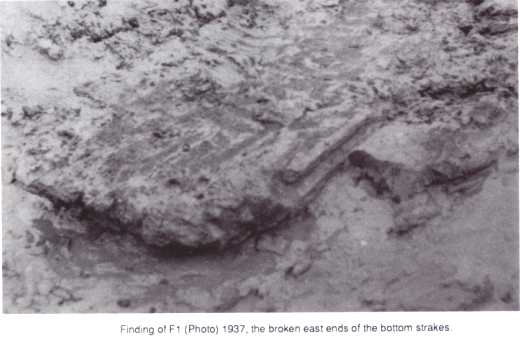
Finding of F1 1937, the broken east ends of the bottom strakes.
On leave from the Army in 1940, Ted found the end of another
boat-plank some 60 yards upstream from F1. This (F2) proved to be most of
a centre-strake of two planks which were joined amidships.
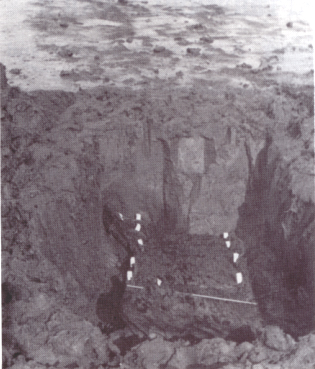
F1: First proper dig (1937)at the western end.
Copyright - Estate
of Edward Wright deceased. As extracted from his booklet 'North Ferriby and
the Bronze Age Boats'